Why Your Website Isn’t Ranking: 10 Technical SEO Fixes from the Best SEO Services Sydney
Published: December 01, 2025

After putting all the hard work into your website, if it’s not showing up for your target customers online, it can be extremely frustrating.
What’s worse is when you can’t figure out why.
If you want your business to be among the top results on Google SERPs, you need the best SEO services Sydney to optimise your website.
There are many reasons for your Google rankings to drop. It could be off-page SEO, on-page SEO, or technical SEO.
This guide outlines the 10 biggest technical SEO issues hurting your Google rankings, using Sydney-based examples, and shows you the exact fixes professional SEO services apply.
Throughout this guide, you’ll also see real examples from Lighthouse performance reports, Google Search Console indexing and crawl data because technical SEO becomes clearer when you see what’s actually happening behind the scenes.
Table of Contents
What is Technical SEO?
Your site could be the most informative site available in the niche you are serving. But if Google can’t find you, there’s no possibility for you to compete on search results. Technical SEO is the process that your SEO specialist follows to make sure your website is found by Google.
Your website is found by Google and other search engines like Bing when it’s crawled and indexed.
Crawling
Google has to crawl sites to add them to its index.
The index is where Google picks your site from.
You can confirm whether your robots.txt file allows Google’s crawlers to access your site with a free robots.txt checker tool available online.
Indexing
To display your site in search results, Google has to index it first.
Search for your site on Google in the following format to confirm whether your site has been indexed:
site:yourdomain.com
By investing in search engine optimisation, you’ll be able to drive organic traffic in the long run. And technical SEO happens to be the part of SEO that can unequivocally rule out whether or not your site can rank.
So Do Small Business Owners’ Websites Require Technical SEO?
If you are a service provider in Sydney, Australia, competing with major contenders who have larger budgets and rich content sites, you can only stand a fighting chance with a precisely curated SEO strategy that truly stands out from others.
So yes, you do need technical SEO. Accurate technical search engine optimisation is essential for search engines to find your site.
The best SEO services in Sydney get their clients to rank on the first page by making sure that every aspect of search engine optimisation is taken care of. This includes:
- on-page SEO
- off-page SEO
- technical SEO
While most digital marketing agencies in Sydney already provide search engine optimisation strategies that cover the basics, expert SEO specialists with years of experience know the ins and outs of technical SEO to pinpoint exactly what’s wrong in your website and fix it.
Reasons You Can’t Rank Due to Technical SEO Issues
These are the benchmarks for your website to appear in search engine results. In other words, if any of these technical aspects are not optimised by an experienced SEO specialist in Sydney, your site will struggle to rank:
- Site speed
- Information architecture
- Mobile optimisation
- Indexing & crawling
- Core Web Vitals
- Broken pages and redirects
- Local schema
- Security
- International SEO
- User Experience (UX)
In the next section, we’ll explore how each technical SEO issue stops your website from ranking and what must be fixed for you to show up on page one.
1. Site Speed
Site speed is one of Google’s confirmed ranking factors.
Slow-loading pages reduce crawl efficiency, increase bounce rate, and prevent pages from ranking well.
7 seconds are more than enough for your visitors to bounce off long before they read the content that converts.
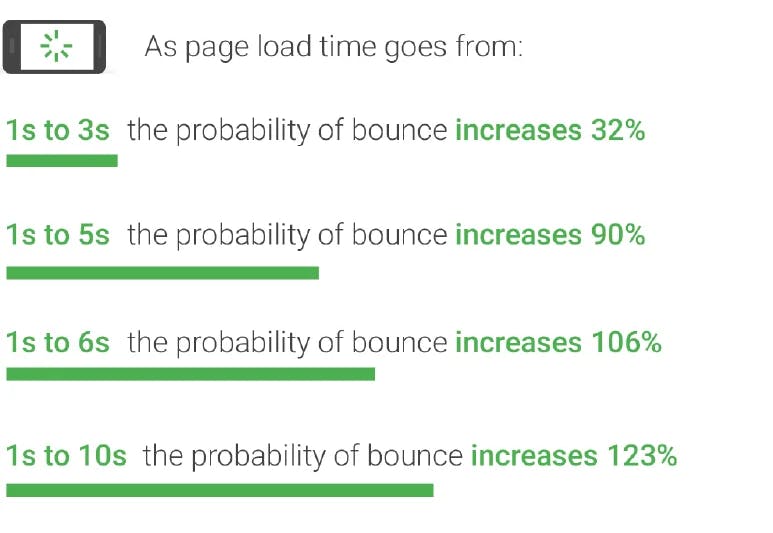
Source: Think With Google (2017)
For example, if your business is a rich content site with multimedia formats and interactive elements, (e.g., a boutique hotel in Surry Hills), and you upload uncompressed 4K hero images, these files push load times past 7 seconds.
2. Information Architecture (Site Structure)
A clear site structure is one of the core technical SEO pillars for your site to rank on the first page of SERPs.
When important pages are buried too deep; for example, a Parramatta law firm placing “Family Law” or “Conveyancing” four clicks from the homepage, Google struggles to crawl them.
What’s more, users struggle to find them too, and rankings drop due to the poor user experience.
You can apply a Screaming Frog crawl and evaluate the site structure and on-page elements of your site.
A Sydney law firm website crawl completed by our AT Digital SEO team during a website audit is given below. It’s a practical example of how the site structure is not properly optimised for SEO.
You can see how long page titles, missing alt text, and structural issues have been flagged:

AT Digital is an experienced digital marketing agency in Australia that makes sure there are no dead ends in your website.
Once our expert SEO specialists fixed these technical issues and regularly tracked performance to remove any new issues detected, this website started ranking higher on SERPs (search engine result pages).
3. Mobile Optimisation
Google now indexes and ranks the mobile version of your site first.
A common example where Sydney businesses have failed in mobile optimisation happens to be cafes and medical centres. Our SEO specialists have observed how these types of businesses have a tendency to still upload desktop-only PDFs, oversized images, or layouts that don’t adapt to smaller screens, forcing users to pinch, zoom, or give up entirely.
What you need to understand is that poor mobile usability not only discourages visitors to remain on your website, it also signals to Google that your site isn’t offering a good experience. Consequently, your rankings drop as Google assumes that your website is not helpful to visitors.
4. Indexing & Crawling
If Google can’t crawl your pages or add them to its index, they will undoubtedly struggle to rank. What’s more, many Sydney website owners unknowingly generate messy, parameter-heavy URLs that overload Google’s crawl budget, leaving key service pages undiscovered and invisible in search.
Given below, in Google Search Console’s URL Inspection tool, you can see an example of this problem.

A page showing “URL is not on Google — Page with redirect”. This is exactly the sort of indexing issue that keeps service pages with good content adhering to E-E-A-T guidelines out of search results until it’s fixed.
5. Core Web Vitals
Core Web Vitals measure real-world experience of your website:
- LCP (Largest Contentful Paint) — loading speed
- CLS (Cumulative Layout Shift) — visual stability
- INP (Interaction to Next Paint) — interactivity
Poor Core Web Vital (CWV) scores directly hurt your site's search visibility.
For Sydney e-commerce stores, anything ranging from unstable hero sliders, oversized images, to heavy scripts can cause high CLS (cumulative layout shift), slow loading (LCP), and laggy interactions (INP), all of which reduce rankings and conversion rates.

Achieving good scores across these metrics can improve search engine rankings and enhance the user experience.
LCP is one of the most important metrics in Google's Core Web Vitals among the set of three metrics that measure a user's experience on a webpage, focusing on loading speed, interactivity, and visual stability.
In the PageSpeed Insights mobile report for a Sydney business given below, you can see exactly how long LCP and speed index delays have led to a poor performance score even though the SEO score is technically “100”.
A high Largest Contentful Paint (LCP) score indicates a slow loading time for a webpage's main content. This leads to higher bounce rates and lower conversion rates.
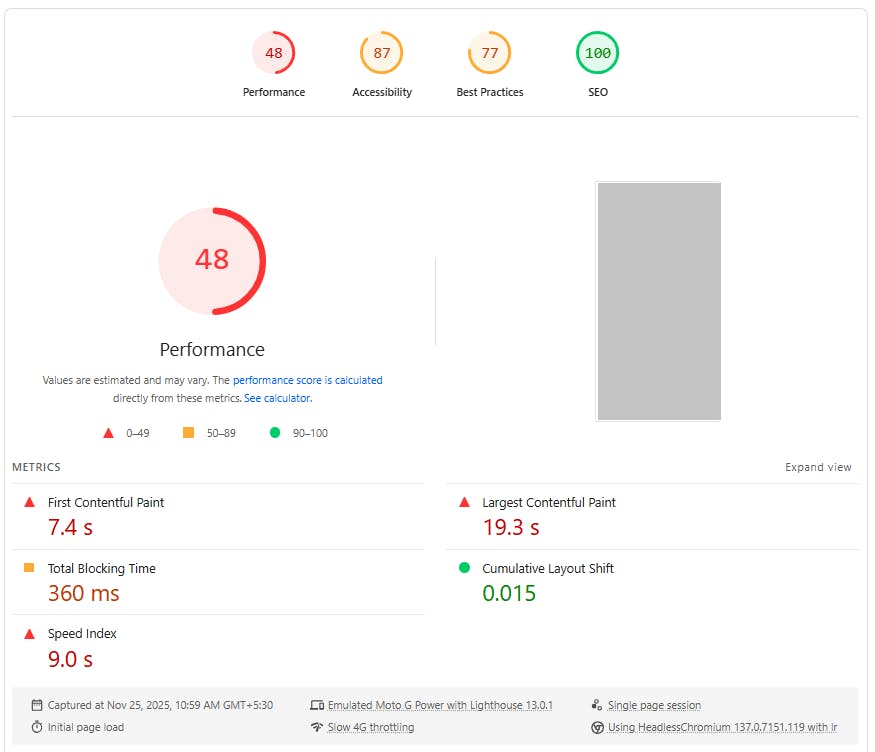
Now compare the overall performance results from PageSpeed Insights after our SEO specialists improved the site speed and decreased the LCP to 3.5 seconds:

This is a real example of how Core Web Vitals impact your site’s user experience and performance.
Since LCP is a key metric in Google's Core Web Vitals, a poor score leads to lower visibility in search results.
6. Broken Pages & Redirects
Two major technical SEO problems caused by broken pages (404s) and long redirect chains are,
- Crawl budget waste
- Weakened link equity
For instance, service sectors such as Sydney cafes and restaurants frequently update menus, rename venues, or run seasonal pop-ups, which leads to outdated links, dead pages, and lost authority if not maintained properly by the best SEO services Sydney.
7. Local Schema
The best SEO services in Sydney include LocalBusiness schema in their technical SEO plan to help Google understand exactly who you are, where you serve, and what you offer.
It gives Google structured, machine-readable information about your business. Without a local schema, important information such as your location, services, or operating hours can be misinterpreted by search engines, thereby hurting visibility in local Sydney searches.
8. Security (HTTPS)
Google gives preference to secure websites using HTTPS. Many older Sydney trade and service sites still load mixed content (images or scripts over HTTP), which triggers “Not Secure” warnings in browsers. This undermines trust, harms conversions, and sends negative quality signals to search engines.
9. International SEO
If you serve multiple countries, Google needs the correct version of each page. Incorrect or missing regional tagging causes major visibility issues.
Google can mix up regional pages, treat them as duplicates, or show the wrong version in Australian search results.
A common Sydney example where the lack of international SEO has a severe impact includes tourism services. Say a tourism operator selling to Australia, New Zealand, and Singapore uses the same content across all URLs without hreflang, this will result in Google showing NZ pages in AU searches.
10. User Experience (UX)
User experience is one of the most critical elements of technical SEO. It includes speed, layout stability, navigation, and accessibility.
For example, if your business is a lawn-mowing website and it’s cluttered with tiny buttons, hard-to-read text, or jumpy layouts that frustrate users, it can quickly hurt your Google rankings. When visitors struggle to navigate a site, they’re far more likely to leave, which makes it harder to compete in crowded Sydney service searches.
That’s why many Sydney web designers rely on usability principles such as Jakob Nielsen’s 10 usability heuristics, which provide clear guidelines for creating websites that are easier for people to use.
How to Fix the Technical SEO Issues Killing Your Rankings
Now that we’ve covered the 10 leading technical SEO problems that websites undergo, it’s time to understand what the fixes are.
One thing that should be cleared beforehand is that these SEO fixes are not going to apply for every situation. Search engine optimisation is not a singular strategy with a one-time fix. It requires ongoing maintenance as well as a combination of other SEO strategies such as:
- On-page SEO
(e.g., Keyword research, Content optimisation, Meta tags optimisation, URL structure, Internal linking, Image optimisation, User experience optimisation) - Off-page SEO
(e.g., Backlink building, Social media marketing, Guest blogging, Influencer outreach, Online PR, Directory submissions, Review generation)
Let’s go through the most common solutions to your Sydney-based technical SEO issues.
Issue | Fixes | Example (Sydney-based) |
|---|---|---|
Site Speed | Compress images, enable caching, reduce page bloat | Boutique hotel in Surry Hills compressing 4K hero images |
Information Architecture | Remove duplicate service pages, create service hubs, ensure shallow click depth | Sydney law firm restructuring navigation for legal services |
Mobile Optimisation | Compress mobile images, ensure mobile responsiveness, optimise booking forms | Medical centre in Bondi optimising for mobile search |
Indexing & Crawling | Clean static URLs, fix robots.txt blocks, submit an XML sitemap | Local plumbing service cleaning up messy URLs for crawlability |
Core Web Vitals | Compress hero sliders, preload main images, optimise JavaScript | Sydney e-commerce site improving LCP score by optimising large images |
Broken Pages & Redirects | Remove redirect chains, fix broken menu links, update schema markup | Sydney cafe fixing broken menu links after renovations |
Local Schema | Validate LocalBusiness schema, maintain NAP consistency, use local targeting | Auto electricians adding suburb targeting for local SEO |
Security (HTTPS) | Ensure HTTPS for all pages, redirect HTTP pages, secure contact forms | Sydney roofing services moving to HTTPS and securing forms |
International SEO | Implement hreflang tags, use regional canonical tags, avoid duplicate content | Tourism operator ensuring Australian version uses "en-au" language code |
User Experience (UX) | Improve navigation, simplify internal links, optimise mobile user flow | Lawn-mowing services improving booking flow in high-mobile areas |

How to Run a Basic Technical SEO Audit Yourself
As search advances with GEO and AEO, SEO services in Sydney for AI-driven businesses now rely on how content, technical SEO, and user behaviour work together. This makes evaluating technical SEO issues in isolation ineffective.
However, you can use the following SEO tools that are freely accessible to run a simple DIY SEO audit and get an overall understanding of how your website is performing:
- Google Search Console: indexing issues, mobile errors, crawl problems
- Google PageSpeed Insights: speed and Core Web Vitals
- Screaming Frog (free version): broken pages, redirects, duplicate URLs
- SEMrush Site Audit (free trial): full technical health report
When assessing your website’s performance, you’ll need to evaluate the site speed and Core Web Vitals in particular.
Also look into the user experience of your site. Even if you don’t understand how to use SEO tools to get data, you can check how your site performs on different devices and see if your target customers can easily find the service you want to sell.
If it’s difficult for your customers to find the service you are selling, then the information architecture as well as the user experience is off.
You can also click on links to different service pages and evaluate if there are any redirect issues.
Why Most Businesses Still Choose Professional Technical SEO Services in Sydney
A DIY audit can show you what’s wrong in a general direction, but it usually can’t show you exactly why your page isn't ranking or how to update the SEO plan to bring organic traffic.
In addition, technical SEO is a complex process where small mistakes like deindexing pages or damaging site structure can create even bigger problems.
Therefore, most Sydney businesses turn to SEO specialists:
- Experts find issues that automated tools miss.
- They understand how Sydney competition and search intent vary by suburb.
- They know which technical fixes deliver the quickest ranking improvements.
- And they ensure nothing breaks during the process.
If you want a site that loads fast, gets fully indexed, and actually ranks in Sydney search results, getting support from the best SEO services in Sydney gives you a stronger, safer, more reliable outcome.
Get your free SEO website audit from the experienced SEO team at AT Digital. We are a team of expert SEO specialists, PPC consultants, and custom web developers ready to help your business grow with customised digital marketing plans in Sydney, Australia.
Need a second opinion?
We help businesses make clearer decisions about PPC, SEO, and website performance.

Build your business smarter
Not sure what’s working, what isn’t, or where to focus next?
Set priorities for growth with a free strategy review of your digital marketing and website.
Tags:
#technicalseo
#bestseoservicessydney
#searchengineoptimisation

Updated: June 9, 2026
Published: December 1, 2025
Need a second opinion?
We help businesses make clearer decisions about PPC, SEO, and website performance.







© 2026 AT Digital. All rights reserved
Disclaimer: The logos shown are for illustration purposes only and do not imply endorsement; all trademarks are the property of their respective owners.